Boat HIN Lookup at Boat-Alert.com
Shopping for a used car, most people know the drill: pull a vehicle history report before signing anything. Shopping for a used boat, that instinct usually disappears — mainly because most buyers don't realize a boat-world equivalent exists. That blind spot is exactly how people end up owning a boat that sat underwater for a season, weathered a hurricane tied to a dock, or turns out to be stolen property from another state entirely.
The fix is straightforward: run a HIN lookup before any money changes hands.
"Boat VIN" Is Really a HIN — Here's the Difference
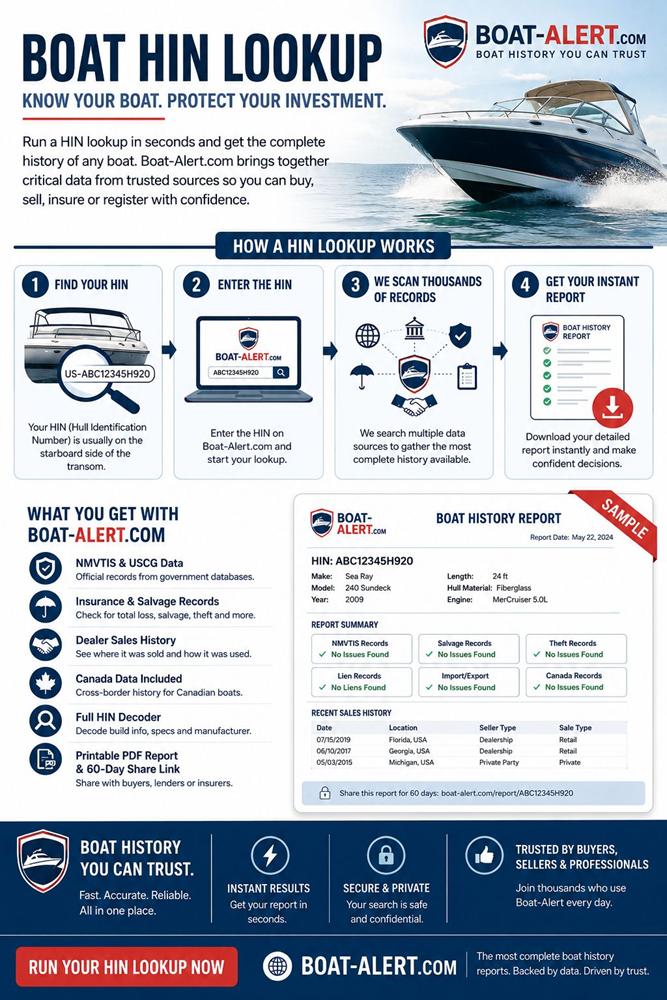
Cars carry a VIN. Boats built for the U.S. market after November 1, 1972 carry the maritime equivalent: a Hull Identification Number, or HIN. It's a 12-character code stamped on the hull — usually on the upper starboard side near the transom — and duplicated somewhere less visible inside the boat, often tucked under hardware, inside a storage locker, or beneath a fitting. When those two numbers don't match each other, or don't match the title, that mismatch is a warning sign, not a technicality.
Since a HIN functions the same way a VIN does — as a permanent, unique identifier for that specific vessel — casual buyers tend to search "boat VIN lookup" out of habit, even though HIN is the correct terminology. Whichever phrase you use, you land in the same place: a check of what the boat's actual paper trail says, as opposed to what the seller tells you.
The Real Cost of Skipping the HIN Lookup
A boat that shines at the dock can still be concealing serious problems. Buyers who skip a HIN lookup commonly discover, too late, that they've bought a boat with:
- Flood, hurricane, or salvage damage that was patched up cosmetically but never disclosed
- Outstanding liens that transfer to the new owner after the sale closes
- A theft history — stolen boats regularly resurface for sale in a different state or province with a bill of sale that looks perfectly legitimate
- A hull number that's been altered or doesn't match the title
- A "washed" title, where a salvage designation gets scrubbed by re-registering in a state with looser rules
Any single one of these issues can leave a buyer with a boat that's hard to insure, difficult to register legally, or worth far less than what they paid.
What a Solid HIN Lookup Report Actually Includes
A worthwhile report goes well beyond confirming a boat's make and model. It should decode the HIN to verify year, manufacturer, and model against the seller's claims, then check that number against U.S. Coast Guard documentation records, state and provincial title and registration databases, insurance total-loss and salvage records, stolen-vessel reports, and pollution or environmental incident history. No single free government database pulls all of that together — doing it manually means contacting half a dozen separate agencies and still risking gaps in coverage.
Where to Run a HIN Lookup
Boat-Alert.com specializes in exactly this kind of consolidated report — often referred to as the boating world's answer to Carfax. The company has operated since 2015, covering boats registered across the U.S. and Canada, and compiles HIN, title, registration, theft, and salvage information into a single report instead of leaving buyers to track down each source individually.
Getting a report is simple: submit the HIN, or the state registration number if that's all you have, and the system cross-checks it against aggregated records covering accidents, pollution incidents, theft, and title issues. Reports start at $29.99, purchased credits carry no expiration date, and every report comes with a 60-day money-back guarantee. More than 30,000 boat buyers have used the service to check a vessel's background before committing to a purchase.
If you're working from an incomplete number, or need to reverse the process and trace a registration number back to a HIN, Boat-Alert's support team can handle that lookup manually on request. And for anyone who wants a free, no-commitment first pass — just the year, manufacturer, and model decoded from the HIN — the company's sister site, HINDecoder.com, offers that at no charge.
Not Just for Buyers
A HIN lookup isn't only a pre-purchase safeguard — it's a useful move for sellers too. Listing a boat on Boats.com, Craigslist, eBay, or BoatTrader? Attaching a clean history report to the listing builds credibility immediately, tends to speed up the sale, and sidesteps the "let me get this inspected first" delay that stalls so many private-party transactions.
Bottom Line
A fresh coat of wax can hide a lot: flood damage, a salvage title, an unresolved lien, or a stolen hull. A HIN carries exactly the same weight for a boat that a VIN carries for a car — the only real difference is how few buyers think to check it. Before you hand over a deposit, take a few minutes and less than $30 to run a HIN lookup. It's a far cheaper lesson than finding out what you actually bought after the sale is final.
Quick Reference: HIN vs. VIN
Feature | HIN (Boat) | VIN (Car) |
Purpose | Identifies the vessel | Identifies the vehicle |
Standardization | Required for boats built after 1972 | Required for cars built after 1981 |
Importance | Critical for verifying title, theft, and damage history | Critical for verifying title, theft, and damage history |
Buyer Checklist Before You Sign
- Confirm the HIN on the hull matches both the paperwork and the secondary hidden number.
- Run a full HIN lookup to surface any hidden salvage, lien, or theft records.
- Choose a service that aggregates data from multiple sources rather than relying on one database.
- If you're selling, share a clean HIN lookup report upfront to build buyer trust.
#HINLookup #BoatVINLookup #Boat #HIN